Shahbaz Bhatti: A Tribute

I’ve interviewed hundreds of people in my time – both the very famous and the nowhere-near-as-famous-as-they-think. Some of them have been on the receiving end of threats (mostly those involved in campaigning for the human rights of others); some have even been attacked once or twice. But this week was the first time that someone I’ve interviewed has been murdered because of the stance he took. I am still in shock, even though it’s been eight years since I last spoke to him.

I met Shahbaz Bhatti (Pakistan’s Minister for Minority Affairs, who was assassinated on Wednesday) in February 2003, when he was Chairman of the All Pakistan Minorities Alliance. He was also Executive Director of Pakistan Council for Human Rights and Democracy and Founder/President of the Christian Liberation Front of Pakistan (CLF). George W Bush and Tony Blair were warming up for their war on Iraq, and Shahbaz was on a tour of Western countries, basically to explain to those in power what sort of nasty backlash Pakistan’s non-Muslim minorities would suffer if the war went ahead.

“I’ve met many policy-makers in Europe, and discussed this issue at length with them,” he told me. “People have shown deep concern towards the situation in Pakistan, and I think that at their own levels, they are taking up this issue and showing solidarity with us.”

Shahbaz was a Christian, but his fight wasn’t exclusively on behalf of Pakistan’s Christian population; he also championed the rights of Hindus, Sikhs, Balmeeks, Bheels, Maingwals, Zoarstrians, Kelashes and all the other groups the All Pakistan Minorities Alliance stood for. All he wanted was to see Pakistan’s non-Muslim communities able to live without fear of harassment – and an end to the blasphemy law which is routinely abused by unscrupulous people; often used to persecute minorities and to steal people’s property by accusing them of blasphemy so as to get rid of them.

The CLF’s job, Shahbaz said, was to protect and defend minorities who are persecuted because of their faith, or through discriminatory laws such as the blasphemy law. The organisation had over 50,000 members, and branch offices in 90 of the 106 districts in Pakistan. Its free legal aid cell provided legal aid and assistance to those unjustly imprisoned victims of blasphemy and other discriminatory legislations. They also provided shelter and material support to victims’ families.

To quote an often-used cliché, Shahbaz was a voice for the voiceless in Pakistan. May he rest in peace.

Click here to hear me in conversation with Shahbaz in 2003.

My weekly round-up

My workmates and I have to do one of these every Friday at work; it helps us keep track of all that has been achieved (or not) over the week. I thought I’d extend the concept to other areas of my life, and see what effect that has on my outlook. And so, in summing up, last week:

My niece turned 14;
I met Martin Sheen and Emilio Estevez (and got paid for doing so!)
I had two nice pub evenings (one for a friend’s birthday and one for another friend’s ‘leaving job’ do)
And a nice pub lunch (with workmates)
And a nice afternoon tea (with an ex-workmate who’s about to start a round of chemo)
Swam for free when the guys at the pool didn’t have change for my £10 note
Had my work contract extended by a few more months (then had a few extra days added, so I could cover a conference).

A few crap things happened as well. But I think I’ma concentrate on these, rather than on the bad stuff. You know, accentuate the positive, an’ ting. Irie, man…

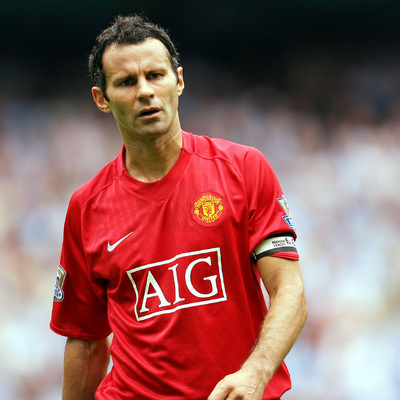
Famous Sierra Leoneans, #2: Ryan Giggs

The most decorated player in English football history makes it onto our list by virtue of the fact that his paternal grandfather is from Sierra Leone.

Not being a footy expert, I can’t waffle on for hours about Ryan Giggs’ dexterity on the pitch, the mastery of his corner kick, and such like. Fortunately, I do know a few people whose knowledge of football is better than mine. So I’ll let one of them tell you why, in his humble opinion, Giggsy rocks…

http://boos.audioboo.fm/swf/fullsize_player.swf

And there you have it.

Famous Sierra Leoneans, #1: Idris Elba

Known to millions of telly viewers as Stringer Bell in the crime series The Wire, London boy Idris is one of the finest British actors in recent years to find success stateside.

Idrissa Akuna Elba was born in 1972 to a Ghanaian mother and a Sierra Leonean father. His journey from Hackney to Hollywood has seen him appear in Absolutely Fabulous, Family Affairs, Luther, The Number 1 Ladies’ Detective Agency and the US version of The Office on telly, and a long string of films that includes 28 Weeks Later, American Gangster and Guy Ritchie’s Rocknrolla. Off screen, he’s also a pretty nifty DJ. spinning tunes under the nom de turntable DJ Big Driis.

Look out for Idris this summer, playing the role of Heimdal in the film version of Marvel Comics’ Thor.

Famous Sierra Leoneans: Intro

Sierra Leone – my tiny corner of the west coast of Africa – celebrates 50 years of independence on the 27th of April this year.

It’s been a not uneventful half-century; there have been some bad times and some truly horrendous times. But Sierra Leoneans are survivors if nothing else – and as my way of celebrating all of us, I’m going to attempt to chronicle the contribution that Sierra Leonean people have made to the world around us. Trust me, we’ve given more to the world than just dodgy diamonds…

Perhaps I should qualify how I define ‘Sierra Leonean’ in this series of blog posts. It’s anyone who has at least one parent (or grandparent) who’s Sierra Leonean. Some may have been born there; some may have lived there for a while (many of them probably haven’t), but as long as they can legitimately claim Sierra Leonean descent, they’re in (we’re a very welcoming and inclusive bunch, us Sierra Leoneans).

So join me as I pay tribute to some fine upstanding people of the past and present – a few of the many bright sparks that hail from this great land (Well, maybe not great in size. But you get what I mean).

This series of blog posts was partly inspired by this website.

Crimea: Day 2

Breakfast at seven? Flippin’ ‘eck! I thought this was a… oh yes, I get it: we’re abroad, but it’s not a holiday. It’s work. Alrighty then, 7.00am breakfast it is…

Today, the action’s taking place in Saki – a town in the north of Crimea. We’d originally been scheduled to depart at 8.00am to make the first distribution (in a school) on time. But yesterday, we’d received a phone call asking if we could arrive half an hour early, as the school was being a bit inflexible with their timetable – which meant that we had to do breakfast half an hour earlier. And so we did… only to receive a phone call as we were driving up to Saki, informing us that the school had now decided to go with our original time slot. These people – don’t they realise that us writers need our beauty sleep if we’re going to do our jobs properly?

The morning started off just wet back down in Simferopol. The further north we drove, however, the colder it got – and when we arrived in Saki, it was freezing. We pulled up in front of the ‘school for Christ’ church where we were warmly welcomed by Alexander, the pastor (who’s coordinating the gift distributions in this area).

Once indoors, we gathered round a huge table. Alexander wasted no time giving us the lowdown on the area and the work the church was doing there. His youth pastor sat in a corner, strumming away at his guitar. We were served tea, coffee and chunky biscuits by an older blonde lady who, we were told, had been a drug addict for 20 years before she joined the church. She popped her head in from the kitchen and said “hello” and “I love you” to us, whilst the youth pastor laid down some Nile Rodgers grooves in the background. It’s real coffee – hot, strong and made without the use of a filter or cafetiere. I let all the grainy stuff settle before I drink it, occasionally wiping it away from the edge of the mug before taking a swig. It’s good coffee, though.

Alexander used the extra time to fill us in a bit more on the history of the area, and we got given a longer history of the place as we drove round. Saki is home to 30,000 people, including many Tatar people who had returned from forced exile (In 1944, 200,000 Crimean Tatars were forcibly exiled in 24 hours, after Stalin accused them of collaborating with the Nazis. 46% of them perished on their way to Central Asia). Saki is famous for its lake, which has an extremely high salt content. People from all over the former Soviet Union come here for its spas and mud treatments – as do people generally who have orthopaedic problems they need treatment for. “In the summer, it’s not uncommon to see more people in wheelchairs than walking normally,” our guide tells us. Nearly all the shops have wheelchair access, and there are over 100 health resorts in the area.

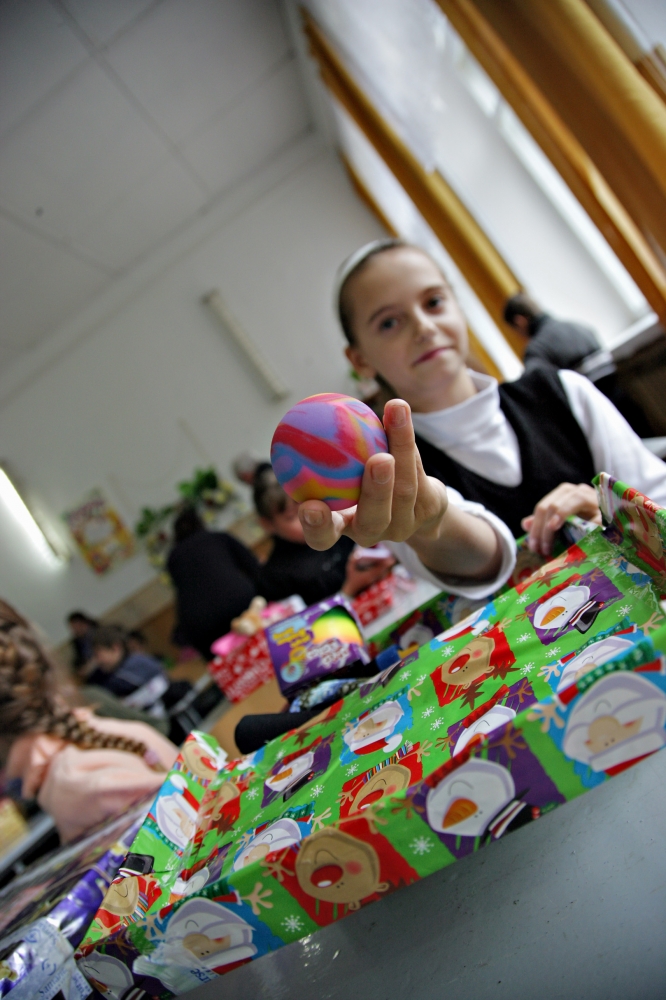
Our first distribution is in the imaginatively named Secondary School No. 4. This school is 300 years old and is the oldest school in the Crimea (which makes you wonder why it isn’t Secondary School No. 1 – but hey, I don’t make the names). I amble about the school’s reception area and am immediately accosted by a handful of girls who want to have their picture taken with me. We take pictures, the school bell rings, and we’re all carted off into a classroom where a handful of kids are given pressies.

I had a brief interview with one girl who loves skipping has found a skipping rope in her shoe box. She told me her name was Lyuda (pronounced “loo-dah”), which immediately reminded me of “Ludachristmas”. But I’m sure she won’t get the 30 Rock reference, so I don’t share the joke. I interview another girl who’s been learning English for a few years and wants to have a practise. That went well… Before we leave, we are warmly thanked by the school principal.

On our way to our next visit, we stopped for a brief wander around the market. An elderly lady in a purple coat sat behind one stall selling stuff; she stopped me and asked where I was from. Thankfully, Marina was close by to help me communicate with her.

“Where are you from?” she enquired.
“England.”
“Oh – so you’re not Nigerian, then?”

She asked if I went to church, and told me proudly that she was a Protestant. Marina explained to her what we were doing in Saki, and she gave us a brief… well, she basically gave us a sermon.

“If you’re doing this for God, and you’re doing it with love, it will be great for this place,” she said. “Do it in God’s honour – not your own. It’s not enough just to give people things; you have to tell them about God’s son and what he did for all of us. You need to tell people that they need to have salvation through Jesus Christ. People need to see Jesus in your lives.”

Sermon over, we got into the van and headed to where the second distribution of the day was due to take place. On this leg of the journey, we had the honour of having the head of the village as our guide. He got into our van and gave us guided tour as we drove – very slowly – through the winding roads of the village. He told us about the slave markets there used to be in this part of the Crimea, and of the various people groups who lived here, including the Karaim and the Tatars.

We had to drive slowly; the Tatars who had built the old town had deliberately constructed the roads in such a way that any invading enemies couldn’t just go charging through them, especially if they were in big vehicles (a strategy which, in my opinion, is a lot more effective than speed bumps). En route to the second distribution (due to take place in the village’s cultural centre), we stopped for lunch and visited a couple of kids and their families: a little girl who has Down’s Syndrome, and another who’s being treated for leukaemia.

Only a couple of us did those visits, as we figured it would be too overwhelming for the girls if the whole team walked in on them. While the rest of us waited outside the girls’ homes, the village head talked excitedly about some new developments due to happen in the village. It’s been chosen as the site for a new Formula 1 track – complete with a little airport to accommodate all the rich people who will be flying in on private jets to watch the races that will be held there when it’s done. He told us to take some ‘before’ pictures of the place as it is now, especially of the road in the potholes.

We arrived at the cultural centre to find a flamboyant Technicolour massive waiting to greet us. School children were dressed in their respective ethnic group’s traditional costumes: Tatars, Gypsies, and several others. A large, round, sugary loaf of bread is presented to us – a Crimean custom for welcoming guests. The loaf is passed round and we all break off a piece and eat it, some choosing to dip it in the little bowl of salt that accompanies it. The loaf is the same sort of bread Sierra Leoneans commonly refer to as “sweet bread” (that is, until they move to England and get a nasty shock when they discover what “sweet bread” means over there. Ew!).

The very schoolmarmy-looking lady who welcomed us at the door MC’ed the reception that followed, at which we were treated to traditional dances from the various people groups present in the village (and Brazil, for some weird, unexplained reason – unless someone can prove to me that Samba has Ukrainian roots!). It’s a great atmosphere; I had a particularly fun time playing with one kid who took a shine to my specs (as babies often do). With so many people packed into a not-very-large venue, this distribution felt a bit shambolic – but still went well.

With two distributions and a couple of home visits done, there was still more work to do before wrapping up today’s packed schedule. On to another internat we went. Again, the sweet bread got passed round as we watched some more singing and dancing… and then off to our fourth and final distribution of the day, in another orphanage nearby. This one looked as if it had recently had some work done on it. We sat in the library/IT room and met with a group of kids there; another group of kids from another orphanage close by were bussed in to meet with us and receive gifts. Today’s “Aww” moment came when one little girl who had always dreamt of having her own Slinky spring opened up her shoebox and found one inside.

We ended an extremely full day with dinner back down at our home base in Simferopol. On the way home from dinner, we bumped into some blokes who thought I was Mike Tyson, for some unfathomable reason. Is it cos I is black, I ask myself?

Pictures taken by David Lund. Check out his official website here.

Crimea: Day 1

Oh crap, it’s cold…

When Operation Christmas Child (the charity that mobilises schoolkids across the UK to fill shoeboxes with gifts for kids in poorer countries) asked me to accompany a team of theirs on a trip abroad, I jumped at the chance. Well, why wouldn’t I? The last time they did, I’d ended up spending ten days in Swaziland, so what’s not to like? Well, maybe the fact that this time round, we weren’t going to Africa but somewhere distinctly less sunny: Ukraine.

Well, at least I got some sunshine on the way here, thanks to the 20-minute change of plane in Istanbul. But as soon as we touched down in Simferopol (in Crimea), it was back to brass monkeys again.

Anyway, that was yesterday. It’s now Monday – the first day of a short trip for which I’m on story-gathering duty. From our base in Simferopol, we headed south to Bahchisaray – the six of us who flew in from London the day before, plus Sergei, Irina (Ira for short) and Marina, our three translators.

It got less snowy (but not necessarily warmer) the further we drove out of Simferopol. The first thing that caught my attention as we neared Bahchisaray was the huge mountain range in front of us: a stunning row of what looked like enormous limestone cliffs, on which several centuries’ worth of erosion had done some awesome sculpting.

Our first stop was Sakalina, a village on the road that leads to Bahchisaray, and further on to Yalta (where Churchill, Roosevelt and Stalin famously met in 1945 to discuss Germany’s fate post-World War 2). ”It’s the last village in this area,” says Igor, the church pastor who’s coordinating the gift distributions we’re observing today. “Many years ago, there were a lot of different nations living here.

“People are very poor here. On the way here, you see lots of empty fields, all bare. As far as prospects for young people go, in this village there’s probably tourism – that is, if young people are prepared to stay here and work at it. There’s a great canyon that you can see as you travel on your way here; there’s also a waterfall and other mountains. These are all places we could bring tourists to; young people could earn money that way. For the most part, young people here tend to stay here. Those who have rich parents who can pay for them to be educated in big cities leave and go to either Sevastopol or Simferopol to be educated.”

In Sakalina we visited an ‘internat’ (a sort of cross between a boarding school and an orphanage) which caters for both orphans and children from dysfunctional families. On arrival, we were greeted by Alexandria (the assistant director of the internat) and Sergei, the student president. Alexandria’s been working here 20 years (“We don’t work here,” she informs us. “We live here.”). The school celebrated its 50th anniversary last year. The kids are very hands-on in the running of the place.

Out in the playground, David (our photographer) and I are accosted by a handful of young lads aged between 11 and 15. they’re all keen on footy; some support local Crimean teams, a few of them like Dynamo Kiev – but as far as Premiership teams go, there’s a lone Arsenal fan and not much else (in fact, there’s a big thumbs down when Man U is mentioned!). They’re also big fans of hip hop music. Eminem gets quite a few name checks.

The assembly hall resembles a small cinema (folding cinema seats tend to crop up in all the places we visit). We’ve brought 19 big boxes with us – each of which contains 10 shoeboxes. In the assembly hall, Alexandra introduces us, Trevor talks about why we’re here, and then Igor addresses the kids, and they’re shown a puppet show telling the Christmas story. Then the gifts are handed out, to much jubilation. A couple of kids are up for chatting after getting their shoeboxes, so we chat.

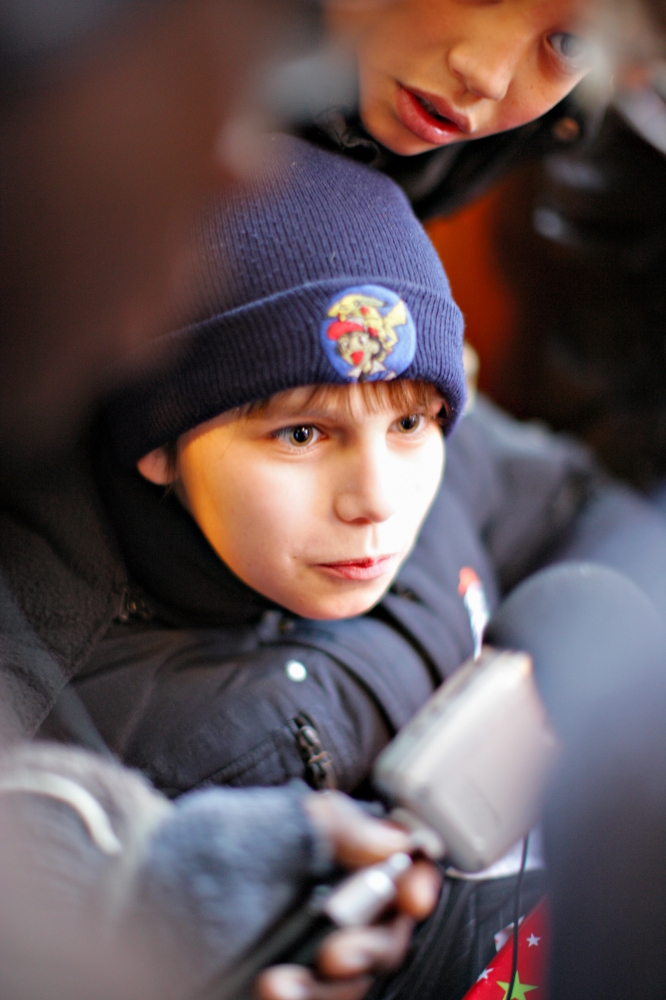
Kirill (left) is twelve and loves Dynamo Kiev and Barcelona. He’ll be leaving school in four years time, and ultimately wants to study medicine. “I want to be the man who gives presents like these to other children.” he says.

I then made friends with 14-year-old Gena (pronounced “gee-yana”). He’d opened his shoebox and found a set of juggling balls inside – and, it turns out, was quite a skilled juggler! “My big brother taught me,” he said, then proceeded to help me brush up on my nonexistent juggling skills. “It’s all in the hands. Put two of them in one hand and just start throwing – like this.”

It’s kind of a cliché for people who travel a lot to say “Aw, people in poor countries; they don’t have much, but they’re so giving.” But it’s a cliché because it’s true… and I was about to get a reminder of that from Gena. After spending a few minutes trying unsuccessfully to get me to juggle properly, he handed me the balls and said they were his gift to me. He then disappeared for a few minutes and returned with a notebook. Since he’d already told me earlier that he liked writing poems, I reckoned that it was his poetry notebook and he wanted my autograph. Wrong – he was giving it to me as another gift! Part of me felt like I was robbing the kid!

After lunch, then set off for the second distribution of the day, in a village called Verhorechye (“the village on the end of the line”). This is one of many places in Eastern Europe that got left behind when Glasnost happened. In the days of the old regime, the village thrived. It was a huge tobacco growing area; it also produced lots of fruit and a thriving bee-keeping industry. All that went into steady decline from 1991 onwards. (“We were okay for about nine years after that, but now there’s nothing here.”) These days, the village’s only employer is a military storage centre. The mum in the last house we visit works there as a book keeper – but, she tells us, the word is that centre is set to close soon.
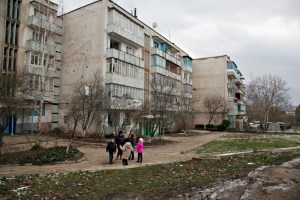
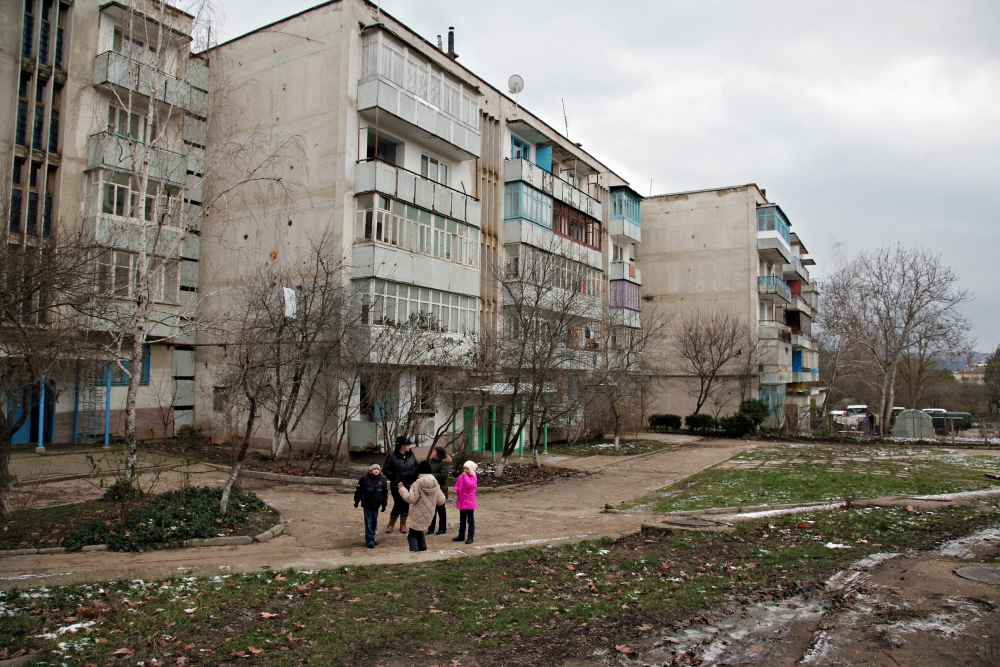
The apartment buildings we visit resemble a run-down council estate. An extremely manky run-down council estate (that’s “the projects” for any Americans reading this). The apartments have back gardens, but even these look bleak. I see a watering can tree in one of the back gardens; two floors up, I can see an old bathtub abandoned in someone’s veranda. The place looks grim. Later on, I ask Igor why he chooses to stay and work in such a place with no prospects. His answer is simple: “God has called me to be here.”

We visited a couple of homes and met a few of the families whose kids will receive shoeboxes when they’re handed out in the nearby cultural centre later in the afternoon. Yaroslava (“Call me Slava; everyone does”) invited us into her home and introduced us to her three kids: Maxim (14), Natasha (10) and Andrez (12).

Slava and her family only moved into their two-bedroom flat a month ago. Her husband Nikolai made all their furniture (he works as a security guard, and was at work during our visit). In the kitchen, one burner on the gas cooker had been left on to help warm the flat up a bit. An accordion and a balalaika took pride of place in the front room – along with Kesha, a beautiful karella (a bird similar to a cockatoo) with a yellow head, a grey back, and a little orange blob on either side of her little face. Kesha sat quietly in her cage, not saying a word. I wasn’t sure whether that was because she doesn’t talk to strangers, or if there was some beef between her and Murchik, the family’s rather enormous grey cat.

The second distribution of the day takes place in the cultural centre, which was built in 1984 and is used for a variety of community events. Nikolai (the director of the centre) gives me a guided tour of the centre, which kind of symbolises the village’s decline. On the wall there are pictures of what it was like in the old days, and of the orchards, tobacco plantations and bee-keepers who once lived and worked here. When I visit the gents’, I find that they’re using old books as loo paper. I can’t read Russian, so I don’t know how important the books are. But all the same, something about that level of desperation just felt wrong.

The guys give out 240 shoeboxes this visit. After they’re done, I chat with a couple of young mums, including Marina (one of about 500 Marinas I encounter on this trip – including the Marina who’s been translating for me). She’s married to a fireman and brought her 18-month-old baby girl along (“She’s always hungry, my little girl. She’s the first child in our family.”)

“You know,” Marina says with a smile, “it’s very important for our village that you people came, because our children here don’t get to meet many people, and don’t get much from people round here. This is a big support for us. It’s a big help. It shows our kids that there’s something more than what they have here.”

Photographs here were taken by David Lund. Check out his art an’ ting here.
My “NaNoWriMovember”

November was an interesting month, to say the least. It did seem to fly by very quickly; I’m not sure how much of that was down to what I spent the month doing. And what was that, I hear you ask? Well, I mostly spent it writing a novel and growing a moustache. Let me explain…

Back in April, I’d spent the month doing the NaNoWriMo (National Novel Writing Month) challenge. That time, I only managed just over 29, 000 words (to be honest, I only really got going on day 23). Still, I learnt a fair bit from the experience – both about the novel-writing process and about myself.

I was in two minds about doing Nanowrimo after that; squeezing out two novels in a year seemed like a big stretch. But even though I had no pre-planned story idea and never really made the decision to do it until three days before kick-off, I jumped in on the first of the month and just wrote a load of stuff. There were a couple of days in that first week when I flagged a bit, but I basically just went with the “just write” advice and just wrote.

I started with a couple of characters just talking to each other – mostly over big dinners or very short chess games (very short because one of them was rubbish at chess and they’d both had a fair bit to drink). Various elements of people I’ve met began to click together to form new characters. After ‘freestyling’ for about a week and a half with three different sets of characters, their paths began to cross and a story began to develop – a story which became a bit more exciting (and totally daft) after I took a friend’s suggestion and wrote a certain reality TV character into the book! (Before I get sued, I should point out that the character in the book is only modelled on him. It’s not him!).

Anyway, to cut a long story short (and other cliches I’ve banned myself from using), I won NaNoWriMo. My word count clocked 51,725 on Day 30 – although according to NaNoWriMo’s word count verifier, it was only 50,056. Either way, that was enough to get me past the 50,000-word target.

Around the time I was twiddling my thumbs over whether or not to join in the exercise in total madness that is Nanowrimo, someone at work suggested that the men in the office join him in participating in ‘Movember’ – where men get sponsored to grow moustaches during the month of November, to raise money for the Prostate Cancer Charity.  Though not a big fan of either beards or moustaches, I thought I’d give it a go. After all, it’s a lot easier to do than writing a novel (if you think about it, it just involves NOT doing something – shaving – and so doesn’t really require much effort). And so I ended up with one seriously itchy caterpillar under my nose… and the campaign to kick cancer’s butt became £60 richer. Thanks to all of you who gave, and didn’t tell me I looked ridiculous.

There's one serious Mo', bro...

November was also special for reasons other than novel-writing and moustache-growing. Among the month’s other highlights, my dad turned 75 and we celebrated with an enormous meal in Rodzio Rico – a Brazilian restaurant in the O2. Two friends got married in a lovely wedding service in the City Temple. On a much sadder note, another friend died after a lengthy bout with cancer (the second friend of mine to die from that vile illness in as many years).

After all that, December’s looking rather unexciting. Still there’s Christmas to look forward to (do adults really look forward to Christmas?) and a few more mundane things to take care of – last year’s tax return being top of the list. Having not done any messing about with music in November, I plan to spend a bit more time working on stuff on the DJ front (expect a mixtape or two up on here before the end of the year).

And that was my “NaNoWriMovember”. It was fun, but I’m kind of glad it’s over.

Are you sitting comfortably? Good. Then I’ll begin…

I’m not a big fan of ‘reality’ TV shows, but one of them has been keeping me entertained quite a lot over the last few weekends. Not the show itself, so much as all the banter that you get on the two main social networking sites when it’s on. In fact, it’s become something of a weekend ritual for me. The show starts; I fire up my laptop and read the barrage of sarky tweets and Facebook status updates that ensue as the show unfolds. Sometimes I don’t even have to have the telly on to enjoy the fun. I’ve been on a train from Sheffield to London with nothing but my laptop and a wifi connection, and still been thoroughly entertained.

Sadly, though, the fun only lasts until Sunday evening when we get the results of the previous night’s voting. That’s when (depending on how the results have gone) the tweets and status comments go from being light-hearted and fun to whiny and vitriolic.

I know that generally we all get upset when our favourite team loses. But for some unknown reason, the people who watch this show tend to take that disappointment to infinity and beyond. Suddenly it becomes a microcosm of everything that’s wrong with the UK. Every now and then, some level-headed soul will try to restore some balance by reminding us that it is, after all, just a TV karaoke show and nothing to get too steamed up about. But that usually just seems to stir up more anger (why are the people who take ‘reality TV’ so seriously always so bloody angry? I thought it was supposed to be light entertainment?). Well, I don’t care anymore. It’s time to point out one simple fact the complainers have clearly forgotten.

So far this series, the highest audience figure this show has had is 12.6 million. That’s a lot of people. But here’s the thing: the population of the UK is 61.8 million. Big though it is, 12.6 million is just a fifth of the country’s population. And that’s just the number of people who watch the thing; the number that actually votes is even lower than that.

People, please bear that figure in mind before making any sweeping value judgements about the state of Britain based on however the results turn out. If the bottom two are black, it isn’t conclusive proof that the whole of Britain is racist (especially if Wagner gets through again, what with him being Brazilian and all). And if Wagner does get through again, please don’t whine about the British public having no taste (at least big them up for having a sense of humour). Remember: it’s (less than) one in five people.

Have a “glass half full” attitude. Instead of moaning about the (less than) one in five Brits who have bad taste in music, why not commend the four who have good taste in music (and who demonstrate that good taste in the most obvious way possible: by simply choosing NOT to watch this bloody programme)?

Oh, and of you’re going to moan generally about “this not really being a singing contest” or “the judges deliberately don’t choose the best singers” – change the record, please. You’ve been watching this show now for at least five years; surely by now you know how it works? Stop making exactly the same complaint every year. You’ve seen the pattern; you know they never deviate from the script; and yet you still choose to watch – so put up or shut up.

Now grab a beer and sit down, tune in and tweet; make those sarky comments on your Facebook statuses, and let’s all have a laugh. Mock the off-key singing, the dodgy hairstyles, the “drunk uncle at a wedding” dance moves and Louis (PLEASE, do mock Louis!). By all means root for your favourite… but keep it light-hearted. Don’t get too precious about the result – or the show itself. Definitely don’t see it in any way, shape or form as an indicator of how the whole country thinks.

Remember, it’s only a TV show.

Train Wreck (a Storypraxis)

As I mentioned in my last blog post, I recently joined the Storypraxis community. This was my first attempt at 10-minute story writing; the prompt was ‘train wreck’. I’ve slightly rewritten it since I posted it on the Storypraxis website – but only just.  

“Pull up a chair,” Anna yelled at Ed and Joe. “This one’s a classic.”

Joe grabbed a chair and joined Anna in front of the large computer screen. Sometimes he felt guilty that he actually got paid to watch people’s home videos—but not for long, because after all, a job is a job. His just happened to be with the company that made one of the nation’s most popular TV shows.

Funny! Funny! Funny! had been an instant hit when it first went on the air four years ago, and work for Joe, Ed and Anna was to sit through the hundreds of videos sent in by viewers, and decide which were worth sharing. A dream job for some; it had been for them when they started it, but the novelty of a skateboarding dog wears off after you’ve seen it two dozen times. Besides, there are only so many times you can watch someone fall over before it gets boring. So if Anna said a video was a classic, you knew you were getting some quality disaster – a train wreck, if you please…

The image on the screen was blurry at first, but gradually you started to make out a primary school auditorium coming into view. A miniature plastic married couple stood atop a ten-storey tower of Babel covered in yellowing icing, which took pride of place on the centre of a high table. As Joe, Ed and Anna watched, a man in a badly fitting beige suit muttered some words before handing his microphone over to another man in an even worse-fitting tuxedo.

The best man clearly hadn’t recovered from whatever it was that he, the groom and their mates had done for their stag night. His fly was open, part of his shirt sticking out of his trousers. He lurched, grabbed the mike… and kept going – all the way down to the floor. He got up, dusted himself and muttered “Is this thing on?” into the microphone.

“Ladies and er, er…” he began. “I flubbalubba, flubbbalubba… I mean… oh boy, I’m plastered! We’re all plastered! Man, what a night last night was! That stripper was off the hook!”

The look on the bride’s face was priceless. The look on her father’s face could have been classified as a weapon of mass destruction. Oblivious to either of them—or to his undone flies—the best man blabbered incoherently, his fist gripping the mike as if his life depended on it.

The groom was even more drunk than the best man, but even in that state he knew his marriage would be extremely short if any more details about their mad stag night became public. No amount of yelling would get the best man’s attention when he was in full alcohol-fuelled flow. He would have to get up, go over and shut the guy up himself. Unfortunately, in his haste to do so, the groom accidentally jerked on the tablecloth. Ed, Anna and Joe watched incredulously as the wedding cake tilted and descended – plastic toy married couple first – onto the best man’s head.

Anna jabbed the pause button on the remote control she was holding. “I think we’ve seen enough,” she choked, tears of laughter streaming down her face.